
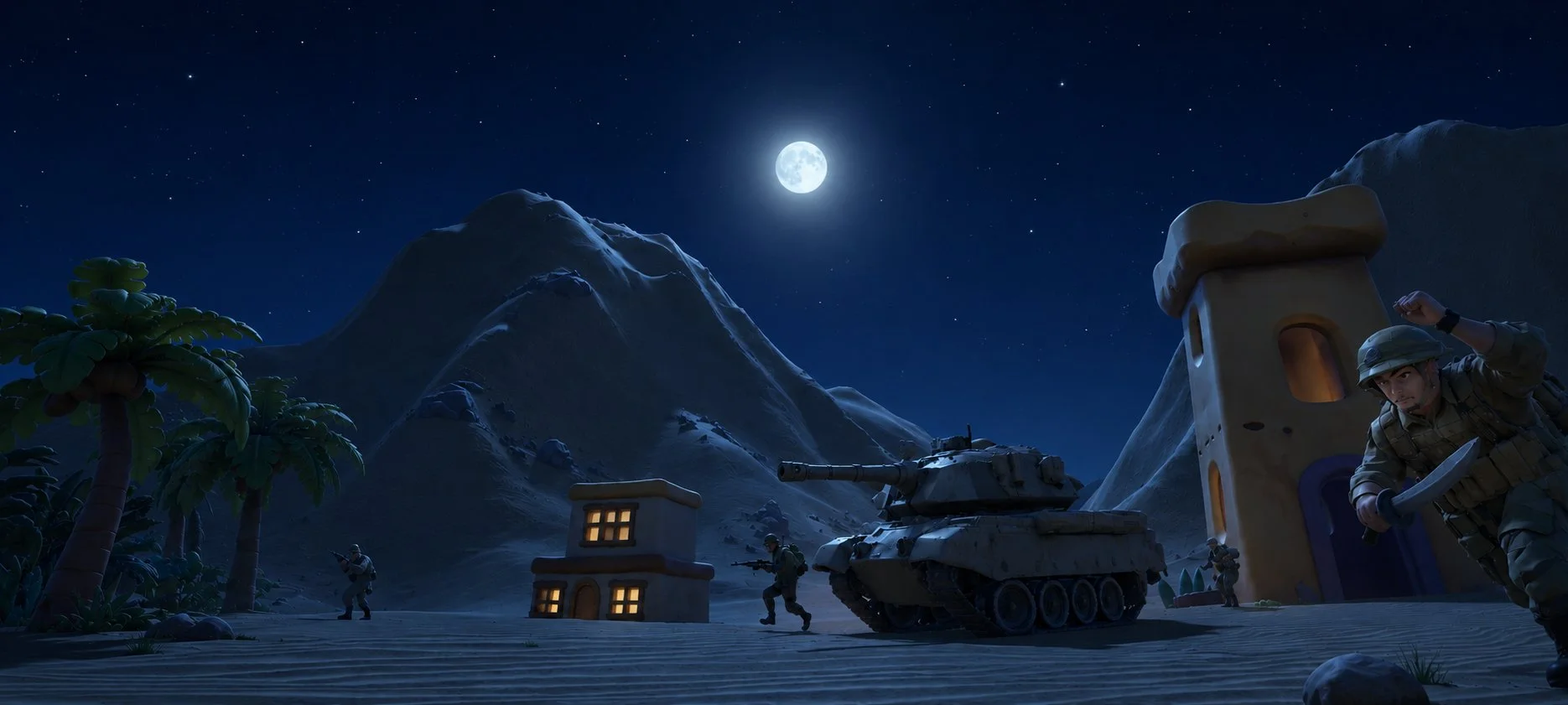
AA War Lane
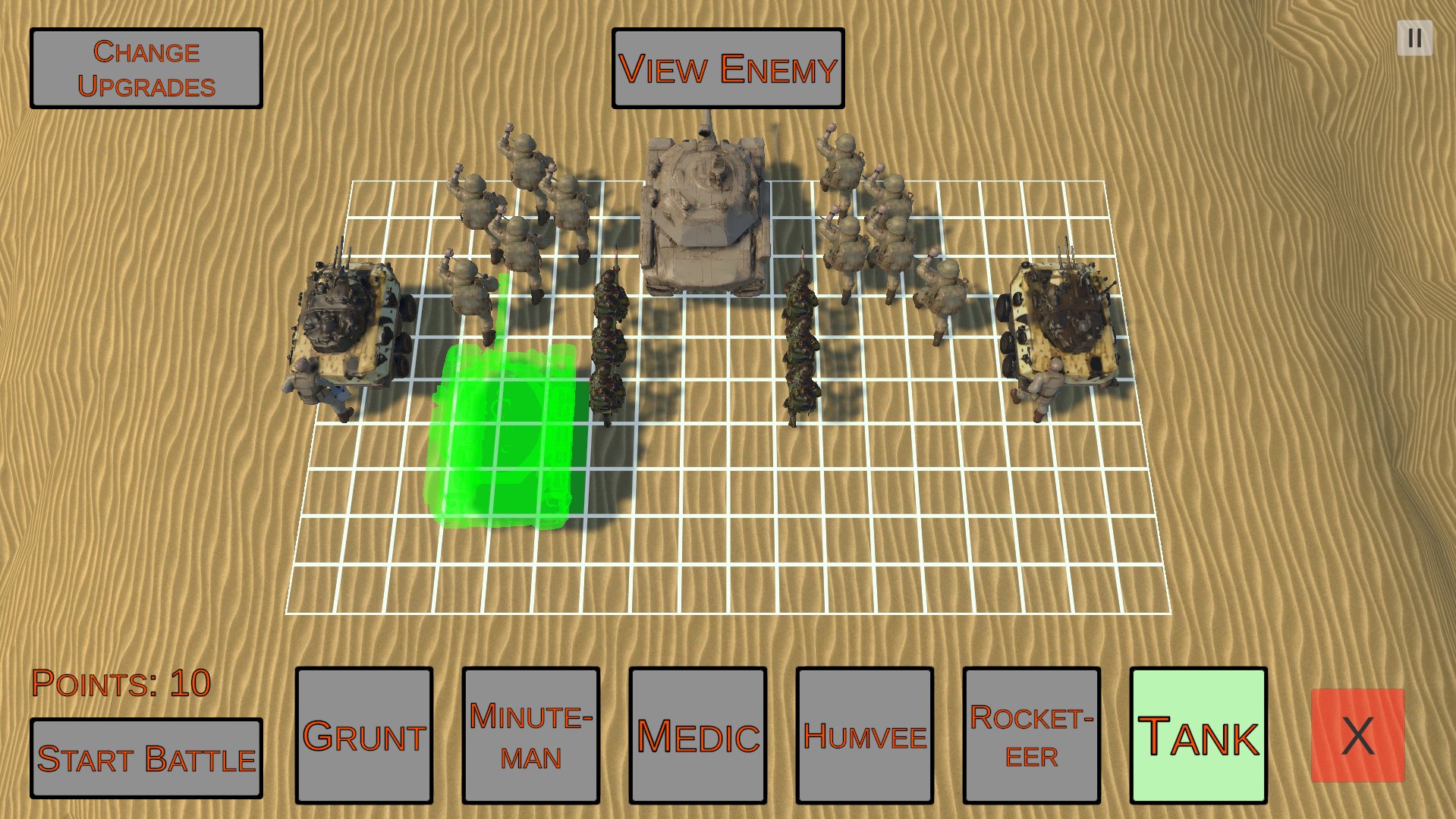
Gameplay Synopsis
The battlefield awaits! AA War Lane is a single-player auto-battler featuring…
Army Formations — Inspect the enemy army, plan your unit composition to counter it and organize your army into an effective fighting formation.
Unique Challenges — Beat increasingly difficult levels that offer new hurdles to overcome.
Unit Variety — Unlock new units as you win more and more levels — learn the advantages and drawbacks they each have to offer and how to best utilize them in your formations.
Tactical Dynamics— Learn which units are best at countering which other units through a steady process of trial and error.
Unit Upgrades — Gain upgrade points after winning each level and invest them into specific unit attributes to strengthen your army.
Personal Contributions
My contributing roles were production, design and engineering. I proposed the game’s concept and consulted with our unit designer to make subtle refinements. I was responsible for all engineering-related development necessary to power the experience (player input, platform compatibility, GUI, etc.).
Game Concept — Initiating the earliest stage of development, I proposed the concept for a stylized, 3D tactical auto-battler playable on desktop and mobile. I came prepared with a setting, gameplay loop and a list of ideas for units with descriptions of their roles.
NPC Combat System — I designed and programmed every feature of NPC behavior from the team functionality, targeting algorithm, attack mechanics, healing mechanics, all the way to the movement functionality for armies to maintain a tactical formation.
Placement System — I handled the implementation of a grid-based unit placement system that is compatible with both desktop and mobile control schemes.
Camera Animation System — I developed a camera system that smoothly transitions between crucial perspectives to give the player key views of the battleground and keep them immersed in gameplay.
Upgrade System — I designed and programmed an upgrade system that serves to complement the gameplay loop by adding an extra layer of planning and strategy to every level.
In-Game Level —The layout I created for the in-game level serves as a practical setting for every battle to unfold and features a background landscape of mountain ridges I sculpted and models I arranged.
*Art assisted by AI.
Game Concept
I derived the concept from the premises of different successful contemporary games in the mobile market. Clash of Clans served as the primary reference; a game where units are dropped into a level and left to automatically attack enemies. Since the traditional real-time army management of desktop strategy games is extremely difficult to replicate on a touch screen, these kinds of games turn strategy into a viable genre on mobile by removing the responsibility of micro-level decision making from players. Recognizing this, I thought up my own take on an auto-battler ported into a feasibly scoped, single-player concept.
Design Goals
Design Process
Key Takeaways
—
NPC Combat System
I knew every NPC in the game needed to be able to act on its own without player input. To achieve this, I created my own algorithm for the combat system that allows units to ignore friendlies, seek out enemies and pick targets which make the most sense in the moment. The result was a fairly optimized and maintainable system that works exactly as intended.
Design Goals
Design Process
Key Takeaways
—
Placement System
The placement system represented a development hurdle that I was willing to tackle and overcome no matter the effort. Its implementation was a noteworthy challenge that taught me many lessons in player input, grid logic, conflict handling and overall game data management. Although this could be said about every feature in every game I develop, I especially feel that I continue to use what I learned in the creation of this system to this day.
Design Goals
Design Process
Key Takeaways
—
Camera Animation System
The camera animation system serves as the player’s eyes for every level of the game. My goal was to create a system that did more than just the bare minimum of showing players what they need to see by snapping between different perspectives. Instead, what I designed is a vehicle for delivering a cohesive sense of spatial presence in the level and a feeling of dramatic impact.
Design Goals
Design Process
Key Takeaways
—
Upgrade System
Upgrades are what tie the whole game together. It is what rewards players for their conquests and imbues a sense of progression throughout the levels. Without the upgrade system, levels would lose an important dimension of strategy and lack the feeling of being stacked on top of one another.
Design Goals
Design Process
… I designed the upgrade system to be consequential for later levels where winning is extremely difficult without the right kind of upgrade balance.
Key Takeaways
—
Up Next
In-Game Level
My thought process behind composing the game’s map layout was to give it a stylized setting which at the same time provides a visual identity and tells an open-ended story. I felt the game deserved an atmosphere capable of elevating it beyond the feeling of an empty prototype and into the impression of taking place in a world of its own.
Design Goals
Design Process
Key Takeaways
—
Jobert: An Explosive Adventure
Side-Scrolling Platformer
Platforming Mechanics Engineer
Handled programming for movement and platforming mechanics. Participated in a team environment to help create the vision.
*Art not representative of my work.